The Entry into Force of Law 2477 of 2025 and the Extinction of Criminal Liability Through Full Reparation
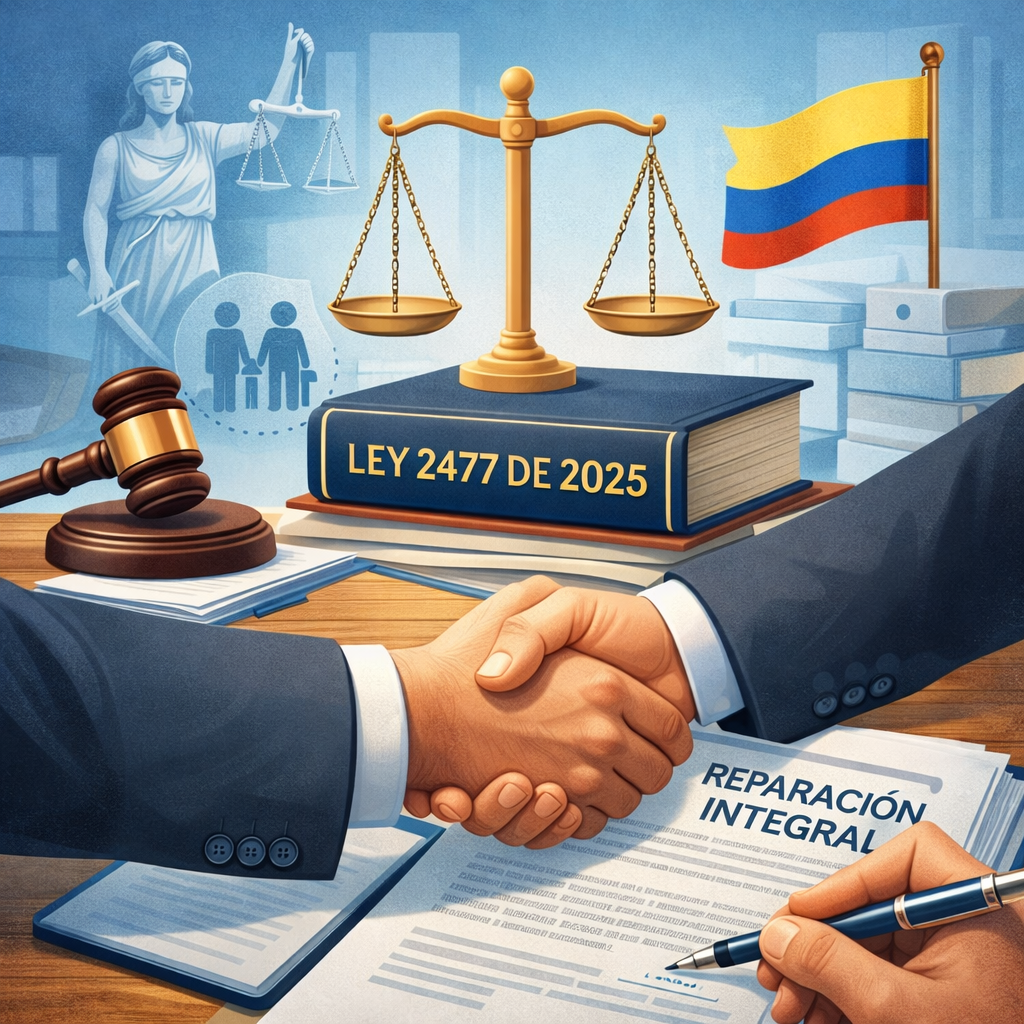
On July 11, 2025, LAW 2477 OF 2025 was enacted in Colombia, amending Laws 599 of 2000[1], 906 of 2004[2], and 1121 of 2006[3] with respect to the figure of full reparation, the granting of benefits for guilty pleas and plea agreements, and the application of the prosecutorial discretion principle (principio de oportunidad), among other reforms aimed at ensuring a prompt and effective administration of criminal justice.
Article 1 of LAW 2477 OF 2025 sets out that its PURPOSE is "to reduce judicial backlog, guarantee an effective administration of justice (…) by promoting the timely and early issuance of judicial decisions through early termination mechanisms that respect victims' rights to full reparation and access to quality justice (…)." In light of the foregoing, this article will focus exclusively on the legal figure of FULL REPARATION (reparación integral) and its consequence of extinguishing criminal liability.
THE INCLUSION OF THE LEGAL FIGURE OF FULL REPARATION IN LAW 906 OF 2004.
With that in mind, Article 3 of LAW 2477 OF 2025 amended Article 77 of the Colombian Code of Criminal Procedure and added "FULL REPARATION" (reparación integral) as a ground for the EXTINCTION of criminal liability.
The legal figure of FULL REPARATION is by no means new — it has been established since the enactment of Law 600 of 2000, in its Article 42. However, its application in proceedings governed by Law 906 of 2004[4] was never settled. This is because the Corte Suprema de Justicia (Colombia's Supreme Court of Justice) frequently shifted its interpretive position on this provision through the application of the PRINCIPLE OF FAVORABILITY (principio de favorabilidad).
Notwithstanding the above, the Criminal Cassation Chamber of the Corte Suprema de Justicia, in decision AP4757-2024, Case No. 62286, reverted to the broader interpretive stance that legitimizes, in proceedings governed by Law 906 of 2004, recourse to the mechanism for the abnormal termination of proceedings set forth in Article 42 of Law 600 of 2000, on the grounds that this legal figure "produces a more rights-protective effect for both the victim and the accused." Under this approach, the victim may obtain effective and full compensation for the harm suffered, while the accused, through this restorative justice mechanism, may reach an appropriate resolution of his or her case.
Quoting directly from that Court's ruling in decision AP4757-2024, Case No. 62286:
*"the figure — in terms of the timeframe within which it may be invoked — is highly favorable to both the accused and victims, in that it allows for a resolution of the effects produced by the offense that is compatible with the restorative justice model embedded in the accusatory system, in order to restore the rights that were violated, up until the corresponding judgment in cassation is issued, that is, well after the conclusion of the oral trial"[5].
WHAT DOES THE LEGAL FIGURE OF FULL REPARATION CONSIST OF?
Article 4 of LAW 2477 OF 2025 added Article 78-A to Law 906 of 2004 (the Colombian Code of Criminal Procedure). That article regulates the application of the legal figure of FULL REPARATION, specifying that it will apply in the following cases:
1.) Offenses that admit withdrawal of the complaint (desistimiento).
2.) Offenses of involuntary manslaughter (homicidio culposo) and negligent personal injury (lesiones personales culposas), where none of the aggravating circumstances set forth in Articles 110 and 121 of the Colombian Penal Code are present.
3.) Intentional personal injury offenses resulting in temporary after-effects.
4.) Offenses against copyright.
5.) The offense of failure to pay child support (inasistencia alimentaria).
6.) Proceedings for offenses against economic patrimony, except for aggravated theft involving violence against persons and extortion.
The same provision makes clear that "criminal liability shall be extinguished for all suspects or accused persons when any one of them provides full reparation for the harm caused," and that it shall equally apply in cases of concurrence of criminal offenses, provided that reparation is individually fulfilled with respect to each such offense.
Likewise, it is important to note that in cases where no victim is known or individually identified, criminal liability may still be extinguished, provided that full reparation is guaranteed through a bond or any other suitable means, as determined by the prosecutor (fiscal).
HOW SHOULD DAMAGES BE ASSESSED FOR PURPOSES OF FULL REPARATION?
The addition made to Law 906 of 2004 through Article 4 of LAW 2477 OF 2025 establishes that FULL REPARATION shall be carried out on the basis of a damages assessment conducted by an expert, unless:
1.) The parties agree on the amount, or;
2.) The injured party expressly states that he or she has been fully compensated.
On this point, the Corte Suprema de Justicia, in Decision AP2671-2020, with a view to giving effect to the purposes of the petition for extinction of criminal liability and safeguarding victims' rights, clarified that an expert from the list of court-appointed auxiliaries must be designated to assess the damages caused, since "it is not possible to simply accept a valuation carried out unilaterally by one of the parties on its own initiative."
This position was reiterated by Panel 09 of the Criminal Division of the Superior Court of Medellín (Tribunal Superior de Medellín) in its second-instance ruling of May 18, 2022, in case No. 05001 60 00206 2011 52236, where the court stated the following:
"(…) The High Court subsequently refined its case law to the effect that in cases where the parties do not agree on the amount of damages, it could not be accepted that one party set the figure and have that estimate imposed on the other (…)"
It is also worth highlighting that LAW 2477 OF 2025 provides that, in cases where an expert assesses the victim's damages, the victim or his or her attorney, as well as the accused or defense counsel, may challenge the expert's report.
In addition to the foregoing, it is important to recall that the Fiscalía General de la Nación's (Colombia's Office of the Attorney General) handbooks on early termination mechanisms have established that, in cases where a victim presents a disproportionate compensation claim, the prosecutor's role should be directed at providing the victim with sufficient information about the extent of the harm and the available compensation options, since "with adequate information, the victim may come to understand that her or his economic claims are disproportionate to the harm suffered"[6].
NOTE: The extinction of criminal liability through FULL REPARATION may not be issued in a separate proceeding with respect to persons in whose favor such a decision has already been rendered on the same grounds within the preceding five (5) years. For this purpose, the Fiscalía General de la Nación shall maintain a record of all decisions issued pursuant to this article.
[1] Colombian Penal Code.
[2] Colombian Code of Criminal Procedure.
[3] The law establishing rules for the prevention, detection, investigation, and prosecution of terrorism financing, among other provisions.
[4] The criminal procedure law applicable to offenses committed after January 1, 2005.
[5] Corte Suprema de Justicia. Criminal Cassation Chamber. Justice CARLOS ROBERTO SOLÓRZANO GARAVITO, AP4757-2024, Case No. 62286.
[6] Principio de Oportunidad, Bases conceptuales para su aplicación (Prosecutorial Discretion Principle: Conceptual Foundations for Its Application), Fiscalía General de la Nación, p. 72.
https://www.fiscalia.gov.co/colombia/wp-content/uploads/PrincipiodeOportunidad.pdf
El asistente jurídico digital de Jurídiconline analiza tu situación específica. La revisión inicial es gratuita.